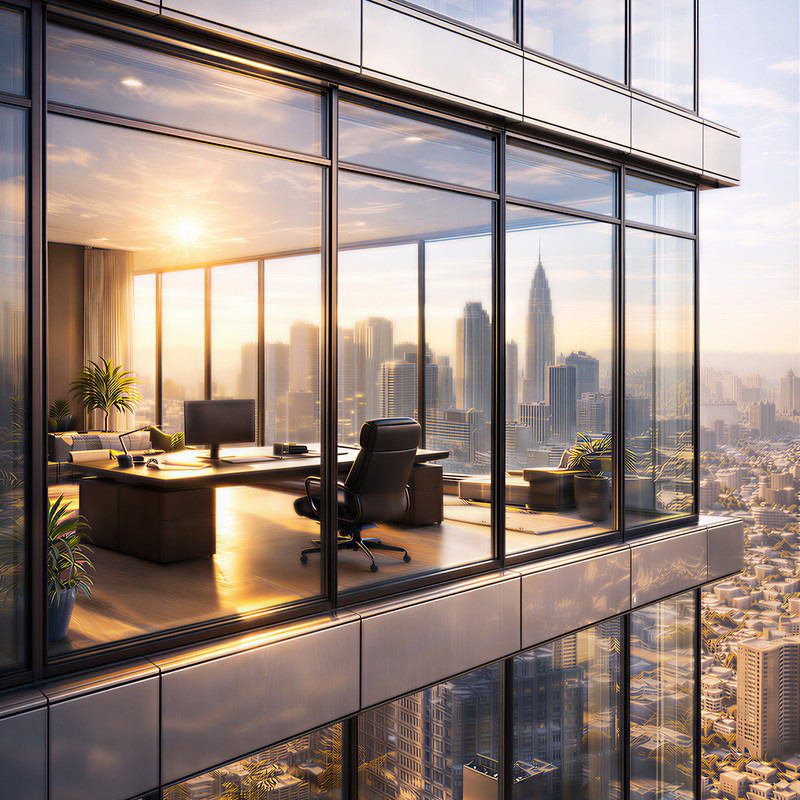




Heat-reduction solar film for interior installation
Interior installation is the most common and most accessible method for fitting solar film on glazing. Because the film is protected from weather, it offers a 10-year service life, and installation does not depend on weather conditions or facade accessibility. Our interior films reject up to 75% of solar energy and filter 99% of UV rays. They are compatible with single glazing and double glazing with a surface area below 1.20 m².
Everything about interior solar film
When should you choose interior installation?
Interior installation is the first reflex when you want to solve overheating on glazing, and in many configurations it is the right choice. It is suitable for single glazing regardless of size, for double glazing up to 1.20 m², and for situations where the outer face of the glass is not accessible, whether on upper floors, in shared buildings, or on difficult-to-access windows.
Its main advantage is film longevity. Protected from weather, wind, rain, and exterior cleaning, an interior-applied film typically lasts 10 to 15 years without notable degradation. Planning is also easier because installation does not depend on weather and can be carried out all year round.
The thermal stress issue on double glazing
This is the key technical point not to overlook. When a solar film is installed on the inner face of double glazing, it absorbs part of solar energy and releases it as heat in the cavity between the two panes. On small panes, this buildup remains moderate and generally harmless. Beyond 1.20 m², however, the temperature difference between the center and the edges of the glass can cause spontaneous cracking without any external impact.
This is why interior installation is limited to small double-glazed surfaces. The 1.20 m² threshold is a recommendation shared by all film and glazing manufacturers. Beyond that size, exterior installation is required. In case of doubt, our technical team checks compatibility before every order.
Performance and available film types
Our interior solar films are available in several performance levels. Silver metallized films, such as SOL 101, provide the highest thermal rejection, up to 75% of solar energy. They also strongly reduce glare and create a light daytime one-way mirror effect. In return, visible light transmission is reduced by about 20 to 40%.
For spaces where brightness is a priority, we offer selective or semi-transparent films that preserve more than 70% of visible light while still rejecting a significant share of infrared energy. These references are particularly suitable for offices, classrooms, and retail areas where thermal comfort and natural clarity must be balanced. Each reference comes with a complete technical sheet including solar factor, light transmission, and energy rejection values.
Installation and application
The film is installed using a wet method. Soapy water is sprayed on clean glazing, the film is positioned, then water and air bubbles are pushed out with a squeegee. The process requires no special equipment beyond a cutter, squeegee, and spray bottle. On tertiary projects, an experienced installer typically treats 30 to 50 m² per day depending on glazing configuration.
Full drying takes 2 to 4 weeks. During this period, small water pockets may remain visible between film and glass: this is normal and disappears on its own. The space can be used immediately after installation. For professionals installing themselves, we provide suitable installation tools and detailed technical guides in our accessories category.


